Building Upon Proven Chassis towards Cutting-Edge Data: A Journey of Drift Vehicle Building
In the intensely competitive world of today's professional oversteer competition, podium finishes is no longer exclusively a product of brute horsepower or pilot bravado. Rather, it is now a multifaceted science that requires a scrupulous fusion of choosing a inherently capable car, arming it with the highest-quality drift-spec hardware, and, most critically, comprehending its real-time behavior on the circuit through cutting-edge suspension tuning applications. This comprehensive guide acts as your roadmap from the very first idea of a project car all the way to the last engineering-refined refinements that turn a powerful car into a predictable champion. We will thoroughly explore the art and science of car suspension tuning, illustrating how a advanced suspension tuning tool like precise measurement hardware eliminates approximation and provides unparalleled visibility into your car's real-world behavior.
The cornerstone of any exceptional competitive sliding vehicle is, indisputably, the base vehicle itself. A select group of vehicles have earned iconic standing within the global drifting scene due to their inherent handling characteristics, robust construction, and the vast ecosystem of performance components available. Selecting the right starting point is the primary and most crucial selection a driver will make. For instance, the BMW E36 is widely regarded as one of the best all-around cars for drifting of history. Its almost ideal evenly distributed mass, coupled with a RWD setup and robust inline-six powerplants, creates a car that is simultaneously accessible for beginners and incredibly capable in the hands of a pro pilot. The next step of this lineage, the BMW E46, builds upon these qualities with a more refined frame, wider stance for improved confidence, and yet a greater degree of lock straight from the factory. Another dominant platform in the professional circuit is the C6 generation Corvette.
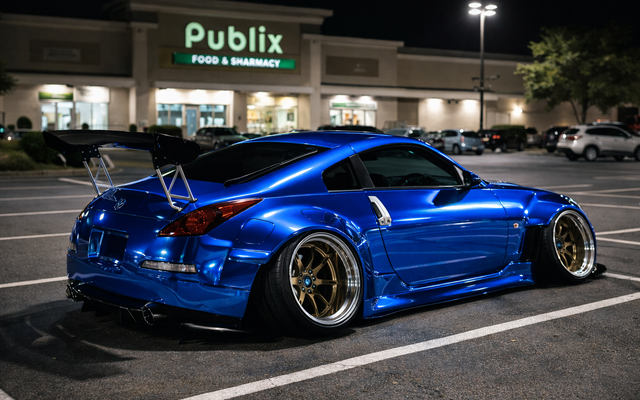
This muscle-derived track weapon introduces a distinctive set of strengths to the sliding world, featuring a light alloy structure, a rear-mounted gearbox and differential unit that contributes to an ideal balance, and the tremendous thrust of a powerful LS-series V8 engine. This fusion renders it an absolute force on track, capable of initiating and holding extended drifts with seemingly minimal use of acceleration. For drivers seeking exceptional value, the Nissan Z33 stands out as a prime choice. It comes from the manufacturer with a robust chassis, a competent original limited-slip differential, and the free-revving V6 engine that offers sufficient performance for mastering and advancing in the discipline. Its newer version, the 370Z model, offers more refinements in structural rigidity, suspension design, and peak motor output, establishing its position as a favorite pick among professional competitors. Additional iconic vehicles that warrant mention encompass the agile unique FC generation RX-7, the ever-present Nissan S13, the torque-rich Ford Mustang SN95, the more recent BMW E90, and the compact yet surprisingly playful and teachable Mazda Miata. Every single one of these cars offers a different set of traits, difficulties, and capabilities, but they all have in common the fundamental ingredients essential to be transformed into a serious drift machine.
However, choosing the right platform is only the starting point. To unlock the full capability of any of these cars, substantial changes to the steering geometry and suspension systems are absolutely mandatory. This is where the domain of precision drift-spec components becomes critical importance. The one most game-changing upgrade for a serious drift machine is the integration of a maximum-angle drift angle kit. These engineered kits, such as those manufactured by specialist companies like specialist manufacturers, are created to dramatically increase the car's available steering angle. A factory production vehicle is highly constrained in how far its steering tires can rotate, a engineering limitation for on-road driving. In drifting, conversely, maximum countersteering is constantly needed to catch and sustain a drift. An angle kit exchanges the stock hubs, linkages, and often A-arms with parts that permit the steered wheels to achieve degrees of turn in excess of 70 or even 80 degs, compared to a normal stock angle of around 40 to 50 degs.
This tremendously increased steering angle offers the pilot with significantly greater command during a angle, allowing it to be considerably easier to initiate a oversteer moment, sustain it through a extended bend, and change fluidly from one side to the other. The difference in drivability is truly revolutionary. Coupled with a appropriately selected modification is the every bit as critical enhancement to the chassis's damping system. Generic or including premium road coilovers are generally not intended for the specific and harsh demands of drifting. A drift-spec pair of suspension units is paramount. These specialized dampers feature specific piston tuning and spring strength that are optimized for the rapid load shifting that is typical of sliding. When a driver initiates a drift, the vehicle's inertia is transferred violently to the outside of the turn. Optimal competition suspension manage this shift in a controllable way, permitting the vehicle to stabilize rapidly and offering the operator precise feedback through the controls and cockpit. They also allow for accurate adjustment of stance, shock absorber stiffness, and corner weighting, which are all key parts of fine-tuning the vehicle's dynamics to a specific venue or competition style. In combination, a top-tier drift angle kit and a expertly specified set of performance suspension units are the undeniable physical base upon which all subsequent tuning is built.
Once the essential components is installed, the following essential phase in the development is the detailed setting of the car's wheel angles. This is the world of vehicle alignment optimization, a methodology that can appear overwhelmingly complex to the newcomer but is, in practice, the defining factor to turning a collection of high-performance components into a harmonious and predictable whole. The most discussed parameter of tuning for sliding is undoubtedly camber. Wheel camber is the tilt of the wheel in relation to the vertical plane when viewed from the front of the car. If the top edge of the tire is leaning towards the chassis, this is called negative camber. In drifting, negative camber on the steering wheels is universally applied and is seen as critical. The purpose is fundamentally linked to physics.
When a car is going around a bend at extreme angles, the chassis rolls towards the outer of the bend. This chassis roll causes the outer front wheel to reduce its ideal grip area with the track surface. By adding inward lean, the wheel is pre-angled to counteract this lean. As the vehicle tilts into the bend, the tire gains a better contact patch with the road surface, optimizing its bite at the critical point when it is needed most for directional command. Usually, front axle camber settings for a dedicated drift car range from approximately -3 degrees to as much as -5 degrees or even greater, depending on the parameters of the car configuration, tire type, and operator preference. The back wheels also utilize inward lean, but the values are generally more modest and subtler than the front axle. Too much negative camber at the rear can make the car excessively tail-happy and hard to manage on throttle use, as it shrinks the effective contact patch of the driving wheels during linear throttle application. Hence, rear axle angles are frequently in the vicinity of -1 degree to -3 degrees, striking a careful equilibrium between offering enough cornering grip to assist in starting and holding the drift while still maintaining good hook-up for exiting the bend. Camber is only one component of the more complex tuning puzzle, which also includes toe, caster, and suspension-induced steering adjustment.
Toe angle refers to the angle of the tires when viewed from above. Toe-in means the front edges of the tires are nearer together than the rear edges, while toe-out means the opposite. For sliding, a slight amount of front toe out is frequently run to improve the initial response steering reaction, making the car feel more responsive and eager to begin a oversteer moment. Rear toe is usually set to zero or a extremely minute amount of inward toe to promote predictability under power. Caster is the frontwards or aft angle of the steering axis when looked at from the side of the chassis. Positive caster angle increases feedback and high-speed solidity, and it additionally boosts negative camber gain during turning, which is highly beneficial. Setting these parameters is a intricate interplay where a adjustment to a single setting can and often will influence the other settings. The conventional method for tuning a chassis's suspension geometry for drifting has for a long time been a labor-intensive endeavor of guesswork and adjustment. A pilot or engineering group would make a change based on experience, test the chassis on track, depend on the operator's subjective feel and comments, and then apply another change. This process would iterate over and over until the car felt "good" or the allotted practice period ran out. This system is not only exceptionally wasteful in terms of time and costs, but it is additionally fundamentally flawed.
Driver perception is a infamously inconsistent metric, colored by many factors such as fatigue, changing track grip levels, ambient heat, and merely the mindset of the driver on that given run. What feels "oversteery" on one pass might feel "pushing" on the following run, leading to contradictory information and counterproductive tweaks. This drift tuning app traditional problem in vehicle dynamics optimization is precisely where modern telemetry systems has made its mark to completely change the methodology.
The development and adoption of advanced vehicle dynamics tools has ushered in a completely new age for engineering and optimizing high-performance drift cars. This new generation of systems, exemplified by cutting-edge products like GripDial, work by actively recording the live physical performance of the chassis as it is being driven on the circuit. In contrast to relying on personal impression, these tools acquire measurable information on critical parameters such as shock absorber movement, wheel speed, G-force loading, wheel angle, and accelerator and brake pedal application. This acquired information flow is then processed by sophisticated software that can plot and interpret the metrics in a comprehensible manner. For the first time ever, drivers and teams can observe specifically what the car is doing at each millisecond of a slide. This ability changes the entire alignment optimization procedure. Think about the specific goal of dialing in the front axle negative camber for a particular car. Rather than making a change from -3 degrees to -3.5 degrees and then driving multiple passes to try and "sense" a difference, a telemetry system can provide instant and clear feedback. The tool can show in a chart how the tire's grip is performing during the critical phases of a angle: turn-in, sustain, and switch. It can demonstrate if the present value is enabling the steering tire to maintain optimal grip or if the tire is over-stressed on its outer edge.
The software can subsequently suggest empirical recommendations for modification. Perhaps the telemetry reveals that the tire is even overloading its edge at -3.5 degrees of camber, implying that a move towards inward lean, say -4 degrees, might be beneficial. Conversely, the data might reveal that the tire is failing to coming up to heat or that the inner edge is degrading excessively, which could suggest that there is too much negative camber and a modest reduction back car suspension tuning to -3.2 degrees would be more optimal. This level of granularity and practical insight was literally unimaginable in the era of pure manual tuning.
The impact of utilizing a advanced vehicle dynamics tool extends well beyond merely setting camber angles. It becomes an essential damper adjustment manual that is specific to your particular vehicle. When setting the damping values on your coilovers, instead of using vague tips or mimicking another car's setup, you can use the data to analyze how the chassis is behaving in relation to your tweaks. The software can show the wheel movement data over a lap, showing if the coilovers are handling the body movement optimally or if they are causing the car to become unsettled excessively after a direction change. It can aid in pinpointing challenges like bottoming out or excessive extension, permitting you to introduce data-backed adjustments to spring preload, damping values, or ride height. This process applies similarly to the complex task of corner balancing. In addition to camber angle, the software can provide analysis into how modifications to toe and caster are impacting the chassis's stability during specific parts of a lap. For example, it can help you to find the best amount of front toe out for your specific angle kit setup and competition style by showing the response time of initial reaction and the predictability of the chassis at full lock. This makes the tool an incredibly effective vehicle dynamics manual that is constantly calibrated by the live performance of your specific car on the circuit. It elevates the entire process from a mysterious craft into a scientific engineering exercise.
Additionally, the utility of a tool like modern telemetry is in no way restricted to experienced tuners with vast resources. For the grassroots enthusiast, it acts as an amazing educational tool. It practically offers the builder with the analysis of a professional suspension specialist without the typical cost. It speeds up the tuning process by providing coilover setup tips unambiguous directions to problems that would normally take seasons of trial and error to solve. A tuner can see how their particular vehicle behaves to specific inputs, gaining a more intuitive understanding of car control in the endeavor. It furthermore democratizes advanced chassis dynamics techniques, allowing every enthusiast with the ambition to optimize their machine to accomplish it in a systematic and successful way. This is notably significant in a activity like sliding, where tuning expertise has in the past been a closely guarded commodity among top teams. Now, that knowledge can be in the hands of any dedicated enthusiast.
In conclusion, the path to constructing and optimizing the ultimate championship-contending drift car is a multi-stage endeavor that seamlessly integrates classic mechanical principles with cutting-edge telemetry solutions. It starts with the informed choice of a capable platform, then enhanced by the installation of critical competition components like maximum-angle drift angle kits and correctly specified competition coilovers. The process then moves into the precision phase of chassis dynamics adjustment, where parameters like camber, toe setting, and caster angle are carefully configured to suit the car's upgraded hardware and the operator's personal needs. The final step, and what genuinely distinguishes the contemporary approach from the traditional methods, is the adoption of a sophisticated drift telemetry software. This system eliminates the uncertainty and trial and error of purely seat-of-the-pants setup by giving quantifiable, real-time information on how the chassis is truly performing. It functions as an indispensable diagnostic aid, a definitive coilover setup manual, and a master vehicle dynamics tool. As a complete package, this integrated approach ensures that all element of the drift machine—from the selection of the chassis to the most minute tweak on the coilover—is optimized for ultimate performance on the circuit. It embodies the full maturation of the art of sliding, connecting physical pilot talent with precise vehicle setup to create the perfect dominant vehicles possible.